



Industrial History · German Connections · European Trade
The Iron Foundries of Norway: From Saxon Miners to European Military Might
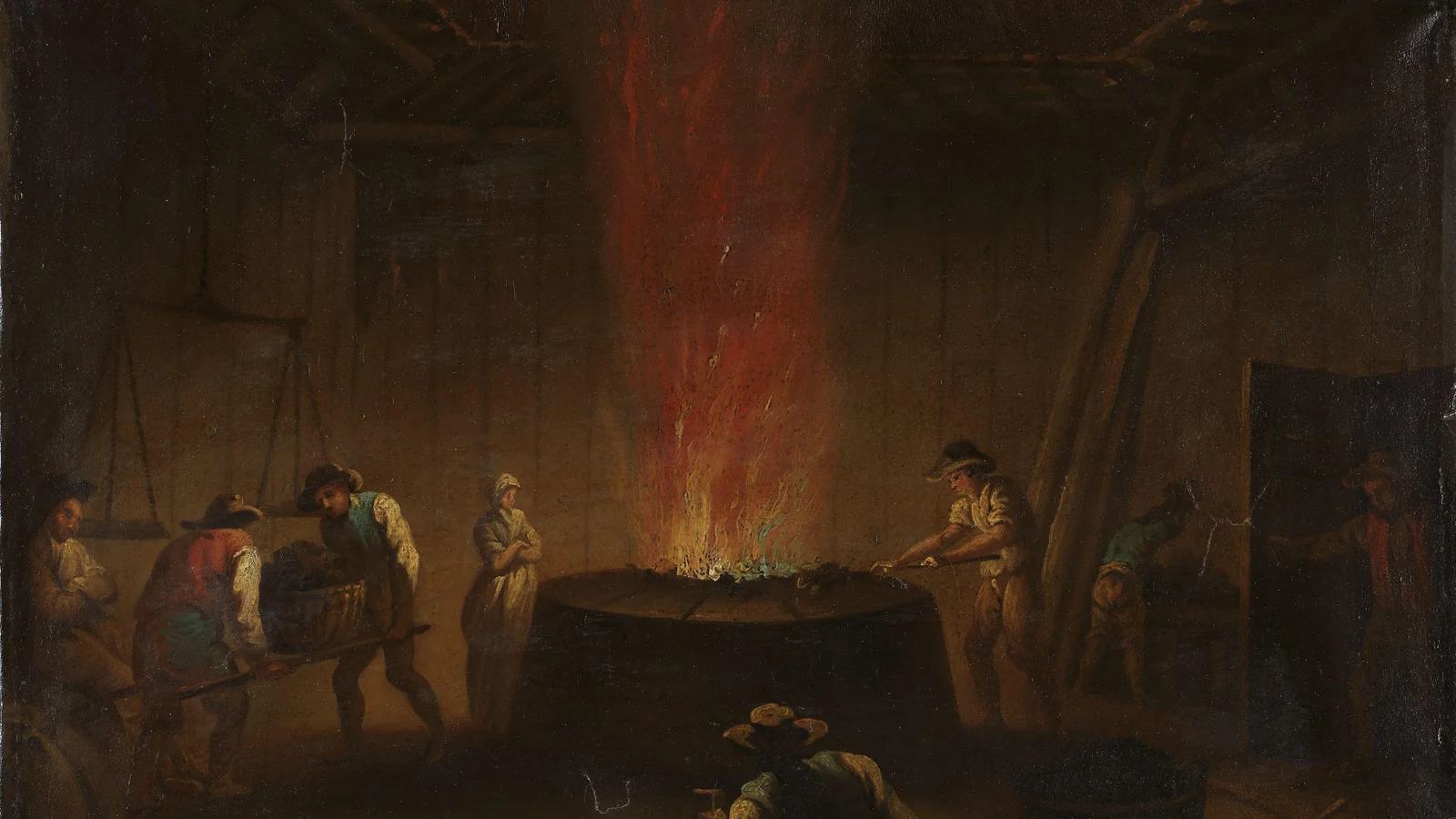
Throughout the 17th and 18th centuries, the night skies across the river valleys of southern and eastern Norway glowed with a fiery, crimson radiance. From deep boreal woodlands echoed the relentless, rhythmic thudding of massive water-driven trip-hammers, accompanied by the furious hissing of enormous leather bellows and the acrid scent of burning pine charcoal and molten slag.
Norway was swept into its first true heavy-industrial revolution: the era of the ironworks (jernverkstiden).
Over the span of two centuries, a handful of Norwegian ironworks — among them Eidsvoll, Bærum, Moss, Fossum, Fritzøe near Larvik, and Næs near Tvedestrand — transformed this rugged northern kingdom into one of Europe’s most indispensable armories and metal producers. Yet this spectacular industrial rise did not happen in national isolation. It was the direct result of imported German metallurgical expertise, a severe ecological crisis across Western Europe, and Norway’s unique abundance of virgin timber and roaring waterfalls.
The German Genesis: Saxon Miners and Imperial Mining Law
Before the mid-16th century, ironworking in Norway was largely a small-scale seasonal activity carried out by peasant farmers. For centuries, rural communities had extracted bog iron from peat marshes using primitive bloomery furnaces. The resulting bloom was soft, malleable wrought iron produced in modest batches — far too rudimentary to cast heavy objects or supply metal on an industrial scale.
When King Christian III (1503–1559) and subsequently King Christian IV (1577–1648) realized that the dual realm of Denmark-Norway was dangerously vulnerable and utterly dependent on foreign arms imports, they turned their gaze toward the epicenter of Renaissance metallurgy: the German mining regions of Saxony (such as Freiberg and Schneeberg) and the Harz Mountains (such as Goslar and Clausthal).
The Mining Ordinance of 1540
During the 1530s and 1540s, the Crown launched an ambitious mining offensive across Norway. To establish a rigorous legal and organizational framework, Christian III enacted the realm’s first formal mining statute: the Mining Ordinance of 1540 (Bergverksordningen av 1540). Printed in German at Zwickau in Saxony, it was modeled directly on Saxon mining jurisprudence and introduced two foundational legal concepts:
- Bergregale (Mining Regalia): The Crown owned all precious and base metal ores beneath the earth, regardless of who owned the surface land.
- Bergfrihet (Mining Freedom): Any prospector who discovered a viable vein of ore possessed the statutory right to claim a mining concession and extract ore, subject to paying a royal tithe.
Because the code was written in German and brimming with specialized Saxon technical terminology that lacked Scandinavian equivalents, ordinary Norwegian peasants understood little of it. Nonetheless, the statute formally remained in force until 1812, creating the legal bedrock for all early modern Norwegian mining.
Language, Guilds, and “Glück auf!”
The new laws were accompanied by a massive influx of German experts: mining surveyors, drainage tunnel engineers, blast furnace masters (masovnmestre), finery forgers, and patternmakers. Major mining centers such as Kongsberg, Røros, Bærum, and Eidsvoll became de facto German-speaking colonies.
For more than a century, German was the official administrative and working language across the works. Miners brought with them their bureaucratic hierarchy and technical vocabulary: Berghauptmann, Bergråd, Geschworner, Markscheider, Schichtmeister, and Steiger. They greeted one another with the timeless miners’ blessing “Glück auf!”, and established the Knappschaft — an advanced, self-governing guild that provided sickness benefits, widows’ pensions, and accident relief long before modern welfare states existed.
Prominent German dynasties shaped these communities for generations. At Eidsvoll Ironworks — originally founded in 1624 under Christian IV’s Jernkompaniet by entrepreneurs Johan Post and Herman Krefting the Elder — the true golden age began in 1688, when the German-born director of mines (Heinrich von Schlanbusch, hailing from the Harz) was granted the works by King Christian V. For nearly a century, through three generations of the von Schlanbusch family, Eidsvoll thrived as a premier metallurgical hub.
Why Did Norway Become an Iron Superpower?
By 1600, Western and Central Europe were gripped by a profound structural ecological bottleneck: catastrophic deforestation.
Smelting a single ton of pig iron in a blast furnace required between 20 and 30 cubic meters of hardwood or softwood converted into charcoal. In England, Flanders, Denmark, and large parts of France and Germany, ancient forests had been systematically cleared over centuries to construct merchant navies, build expanding cities, and cultivate grain. Without charcoal, blast furnaces starved and fell cold. Coke (processed mineral coal) was not successfully deployed for commercial iron smelting until Abraham Darby’s innovations in 18th-century Britain.
Norway, by contrast, offered a combination of natural advantages that made it the ideal metallurgical sanctuary of early modern Europe:
1. Limitless Boreal Forests and the “Circumference”
The expansive taiga forests of spruce and Scots pine across eastern and southern Norway offered what seemed like an inexhaustible reservoir of fuel. To guarantee steady supplies, the Danish-Norwegian Crown granted each ironworks a circumference (sirkumferens) — an exclusive territorial monopoly spanning a radius of three to four Old Norse miles (roughly 30 to 45 kilometers) around the works. Farmers within the circumference were legally obliged to fell wood, burn it in charcoal kilns (kullmiler) during autumn, and haul charcoal sledges to the foundry storehouses in winter at state-mandated prices.
2. Relentless Water Power (Fossekraft)
A blast furnace was an unrelenting industrial beast that operated continuously day and night for six to nine months at a stretch. Giant leather bellows pumping blasts of air to reach 1,200 °C, as well as trip-hammers weighing up to half a ton, demanded constant mechanical horsepower. Norwegian rivers — such as the Andelva at Eidsvoll, Lysakerelva near Oslo, Mosselva, and Farriselva at Larvik — provided steep gradients, lake reservoirs, and thunderous currents that flat agricultural regions like Denmark or the Netherlands could never match.
3. Pure Magnetite from the Arendal Ore Field
The iron ore extracted along Norway’s Skagerrak coastline — especially from the Arendal Field between Fevik and Tvedestrand — enjoyed legendary renown across Europe. It was exceptionally pure magnetite ore, extraordinarily rich in iron, low in detrimental phosphorus and sulfur, and naturally blessed with manganese. This unique chemical profile yielded charcoal-cast iron of unmatched tensile strength, toughness, and elasticity. These coastal ores were complemented by inland deposits such as Skreia at Toten, Grua in Hadeland, and Feiring near Lake Mjøsa.
4. Ice-Free Fjords and Cheap Sea Freight
Whereas inland ironworks in Germany or Bohemia were hindered by expensive, painfully slow overland carriage along rutted dirt roads, Norwegian foundries lay directly on navigable fjords or river systems connected to open water. Ore, charcoal, and limestone could be carried on barges or winter ice, while heavy iron bars and ordnance could be hoisted straight into the holds of ocean-going merchant ships.
Export to Europe: Cannons, Navies, and Continental Agriculture
From the mid-17th century onward, Norwegian iron was a vital strategic commodity on the chessboard of European geopolitics. The foundries produced two main classes of metal: cast iron (støpejern), poured straight from the blast furnace into molds for cannons, ammunition, stoves, and pots; and bar iron (stangjern), refined and hammered into dense billets for blacksmiths and shipbuilders.
Ordnance of War: Cannons That Did Not Burst
The 17th and 18th centuries were scarred by near-constant warfare: the Thirty Years’ War, the Anglo-Dutch Wars, the Dano-Swedish conflicts, the Seven Years’ War, and the French Revolutionary and Napoleonic Wars.
Naval admirals and field commanders had an insatiable appetite for heavy artillery. Norwegian foundries such as Moss Ironworks, Fritzøe, Fossum, Bærum, and Hassel earned international acclaim for their cast-iron naval cannons. While cannons cast from brittle, high-phosphorus iron were notorious for bursting under repeated firing — often killing their own gun crews — Norwegian charcoal iron possessed superior elasticity and could withstand tremendous explosive pressures.
Norwegian cannons, swivel guns, round shot, and canister were supplied by the thousands to the Royal Dano-Norwegian Navy at Copenhagen, while substantial quantities were officially and covertly exported to the Dutch Republic, Britain, and France.
The Maritime Backbone: Supplying Dutch Shipyards
During the Dutch Golden Age, the Netherlands was Europe’s maritime powerhouse. Dutch shipyards consumed massive quantities of Norwegian timber, but they also depended heavily on Norwegian metal. Foundries supplied heavy bower anchors, rudder pintles, chains, iron ballast, and millions of forged ship nails (skipsspiker) to Amsterdam, Rotterdam, and Zaandam. Dutch merchants recognized Norwegian bar iron as an exemplary raw material for harsh North Atlantic voyages.
Bar Iron for Continental Craft and Agriculture
Forged bar iron was the industrial semi-finished product of its day. Merchant houses in London, Hamburg, Lübeck, and Amsterdam shipped crates of Norwegian iron bars to urban workshops and rural hamlets across Europe. Village blacksmiths transformed Norwegian iron into:
- Plowshares, coulters, harrows, and spade tips that revolutionized European food production.
- Iron wheel tires, carriage axles, and horseshoes that sustained overland commerce.
- Structural tie-rods, anchor plates, and masonry cramps that braced rising cathedrals, town halls, and merchant tenements.
- Woodcutter axes, two-man saws, and chisels that powered forestry and carpentry.
Cast-Iron Stoves: Engineering and Folk Art
Alongside armaments, Norwegian cast-iron stoves (støpejernsovner) emerged as a major cultural export. Foundry artisans carved wooden relief patterns depicting intricate biblical scenes, classical mythologies, allegorical virtues, and royal coats of arms. These ornate heating stoves from Bærum, Eidsvoll, Næs, and Fritzøe warmed palaces, guildhalls, rectories, and affluent homes across Denmark, northern Germany, and the Baltic, celebrated simultaneously as thermal marvels and prestigious art objects.
The Danish Iron Monopoly (1730–1814)
In 1730, King Christian VI bestowed upon Norwegian ironmasters an extraordinary economic advantage: the Danish Iron Monopoly (jernmonopolet). The decree completely banned the import of foreign iron into Denmark, granting Norwegian foundries exclusive rights to supply the entire Danish kingdom. This protective wall insulated Norwegian ironmasters from Swedish and English competition, ensuring guaranteed sales and immense fortunes throughout the 18th century. By the 1780s, roughly half of all Norwegian iron went to Denmark, while the remainder competed successfully in global export markets.
Eidsvoll Ironworks: From Industrial Titan to the Cradle of Democracy
Eidsvoll Ironworks holds a revered place in both Norwegian industrial and political history. Situated along the rushing waters of the Andelva, it was founded in 1624 under royal charter specifically to arm the armies of Christian IV during the Thirty Years’ War.
Under the German Schlanbusch dynasty throughout the 18th century, Eidsvoll developed into a bustling industrial village complete with blast furnaces, dual finery forges, nail smithies, a casting house, grain mills, a timber sawmill, and more than thirty workshops and dwellings.
In 1794, the works was acquired by the visionary timber merchant, diplomat, and statesman Carsten Anker (1747–1824). Anker embarked on an ambitious modernization of the ironworks, established Feiring Ironworks nearby to tap local ores, and rebuilt the estate’s manor house into a magnificent neoclassical residence: the iconic Eidsvollsbygningen.
In the fateful spring of 1814, when 112 delegates assembled to draft the Constitution of Norway and declare national sovereignty, they gathered in Carsten Anker’s private drawing rooms. Right outside their windows, waterwheels churned, trip-hammers pounded, and the blast furnace belched smoke over the Andelva. Several of the Constitution’s most influential framers were ironmasters themselves — most notably historian and industrialist Jacob Aall of Næs Ironworks.
Today, while the blast furnaces and hammer sheds have vanished, the historic landscape remains. The 18th-century stone Powder House (Krutthuset) stands intact, slag heaps line the riverbanks, and the Industrial Heritage Trail along the Andelva reminds visitors that modern Norwegian democracy was forged at the epicenter of the nation’s heaviest industrial complex.
The Sunset of Charcoal Iron and Its Enduring Legacy
The golden age of charcoal iron lasted as long as timber remained the world’s primary metallurgical fuel. In the early 19th century, a rapid succession of geopolitical and technological shocks brought the era to a close:
- The Rise of Coke and Puddling: British innovators perfected coke-fired smelting and the puddling process, enabling the mass production of cheap structural steel at a fraction of the cost of Scandinavian charcoal iron.
- War and the Loss of Monopoly: The Napoleonic Wars, British naval blockades, and the Treaty of Kiel (1814) shattered the Danish-Norwegian union. The lucrative Danish iron monopoly vanished overnight.
- Financial Collapse: Exposed to cutthroat international price competition, Norwegian ironworks buckled. Carsten Anker went bankrupt in 1822, and Eidsvoll’s blast furnaces fell cold forever.
Over the 19th century, foundry after foundry shut its gates. A few survived by retreating into specialized high-purity niches, producing crucible tool steel for precision European cutlery and engineering where charcoal-smelted iron remained without equal. The very last charcoal-fired ironworks in Norway, Næs Ironworks near Tvedestrand, maintained its blast furnace until 1909.
When the fires finally went out, the ironworks era left behind a transformative legacy. It imported cutting-edge European science and institutional organization, created Norway’s first organized industrial working class, generated the mercantile capital that financed modern shipping, and linked the remote forests and fjords of the North inextricably to the navies, cities, and workshops of early modern Europe.
Questions about The Iron Foundries of Norway: From Saxon Miners to European Military Might?
Tell us what you are looking for or when you wish to arrive. We are happy to advise and assist.
Write to Ophuz