






Polar History · Norway-Belgium Relations
The Belgica Expedition and Adrien de Gerlache: Antarctic Pioneer Feat and Norway's Ties with Belgium
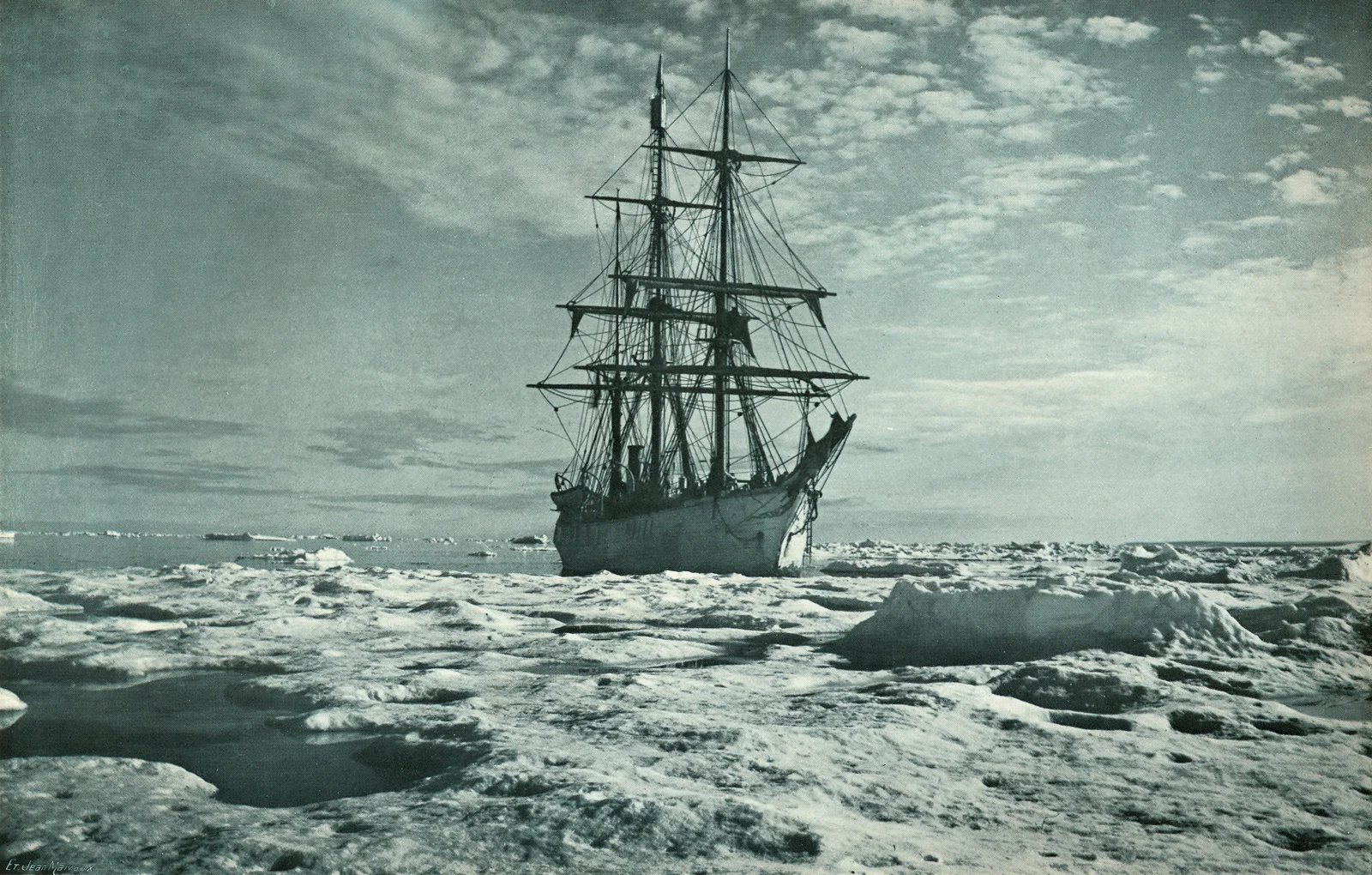
In August 1897, a three-masted converted sealing barque sailed out of the port of Antwerp toward the tempestuous, uncharted seas of the deep south. Standing on deck was a 31-year-old Belgian naval officer, Baron Adrien de Gerlache de Gomery (1866–1934), leading an exceptionally diverse international crew. Few could have foreseen that this expedition would write one of the most dramatic and consequential chapters in the annals of polar exploration.
Aboard the vessel Belgica, de Gerlache accomplished history’s first purely scientific expedition to Antarctica, and his crew became the very first human beings to endure and survive a complete winter trapped deep within the Antarctic pack ice.
Among the crew was a 25-year-old Norwegian who had volunteered to sail without pay to learn the craft of polar voyaging: Roald Amundsen. The Belgica expedition became Amundsen’s great apprenticeship and the launchpad of his legendary polar career, while simultaneously cementing a profound and enduring historical bond between Norway and Belgium.
A Norwegian Ship and an Audacious Belgian Initiative
At the Sixth International Geographical Congress held in London in July 1895, delegates declared the exploration of the Antarctic to be the greatest remaining geographic quest on Earth. While Belgium’s King Leopold II focused his ambitions almost entirely on the Congo Free State, the young de Gerlache rallied private donors, scientific academies, and the Belgian public to mount a major scientific venture under the Belgian tricolor.
To secure a vessel capable of withstanding the punishing pressures of polar ice packs, de Gerlache turned to the undisputed masters of polar seafaring: Norway.
In Sandefjord in 1896, he purchased the steam-assisted sealing vessel Patria, built in 1884 in Svelvik and designed by the legendary naval architect Colin Archer — the mastermind behind Fridtjof Nansen’s polar ship Fram. De Gerlache had the vessel reinforced with dense oak sheathing, outfitted with laboratories, and rechristened the Belgica.
The nineteen-man crew was remarkably international and forward-looking:
- Belgian leadership: Adrien de Gerlache (commander), Georges Lecointe (captain and chief navigator), and Lieutenant Émile Danco (physicist and magnetician).
- Six Norwegian mariners: Roald Amundsen as first mate, Adam Johansen, Ludvig-Hjalmar Johansen, Johan Koren (just 17 years old, later an accomplished Arctic naturalist), Halvardus Ries, and Carl-August Wiencke.
- World-renowned scientists: Polish geologist Henryk Arctowski, Polish meteorologist Antoni Bolesław Dobrowolski, Romanian zoologist Emil Racoviță, and the American physician and photographer Dr. Frederick Cook.
Tragedy in Drake Passage and the Discovery of the Gerlache Strait
The voyage southward took the crew through Madeira, Rio de Janeiro, Montevideo, and the intricate channels of Tierra del Fuego and the Strait of Magellan. Here, the scientists observed the indigenous Selk’nam (Ona) people and carried out hydrographic depth soundings that corrected decades of outdated British Admiralty charts.
As the Belgica ventured across the notorious Drake Passage toward the Antarctic Peninsula in January 1898, a fierce gale battered the ship. Heavy coal bags shifted across the deck, blocking a scupper. Nineteen-year-old Norwegian sailor Carl-August Wiencke of Christiania (Oslo) rushed to clear the debris when a colossal wave swept him overboard. Captain Lecointe courageously jumped into the icy waters with a lifeline in a desperate rescue attempt, but Wiencke was swallowed by the swells.
Grief enveloped the crew. De Gerlache permanently memorialized the young Norwegian sailor by naming one of the expedition’s largest newly discovered landmasses Wiencke Island.
Shortly thereafter, Belgica entered completely uncharted waters, discovering a 200-kilometer strait separating the Palmer Archipelago from Graham Land. Originally named Détroit de la Belgica, it was later renamed the Gerlache Strait in honor of the expedition’s modest commander. They charted and named Brabant Island, Anvers Island, and the majestic Lemaire Channel.
Locked in the Pack Ice: The First Antarctic Wintering
In mid-February 1898, eager to push scientific boundaries, de Gerlache pressed southward into the frozen Bellingshausen Sea. The polar summer was ending. On 4 March 1898, impenetrable pack ice closed tightly around the hull at 71°22’ S. The Belgica was hopelessly locked in the ice.
No human expedition had ever experienced the Antarctic winter. For over thirteen grueling months, the ship drifted helplessly with the frozen pack, completely cut off from civilization:
- The Polar Night and Cold: From May to July 1898, the sun vanished below the horizon. The relentless ice pack groaned and crushed against the wooden timbers with deafening roars, while temperatures plummeted below -30°C.
- Scurvy and Despair: The lack of sunlight, damp living quarters, and salted rations caused rampant scurvy, cardiac distress, and debilitating mental despair. Physicist Émile Danco succumbed to heart failure on 5 June 1898 (Danco Coast honors his memory), while Norwegian sailor Tollefsen suffered a severe psychological breakdown.
- Cook and Amundsen’s Lifesaving Treatment: Dr. Frederick Cook and Roald Amundsen recognized that canned, salt-heavy food exacerbated scurvy. Venturing out on the ice, they hunted fresh seals and penguins, compelling the reluctant men to eat raw, blood-rich meat packed with natural Vitamin C. Cook also instituted open-stove light baths and daily exercise around the ship (dubbed the “madhouse walk”). The regimen revived the dying crew and restored their strength.
The Heroic Escape through the Ice Canal (1899)
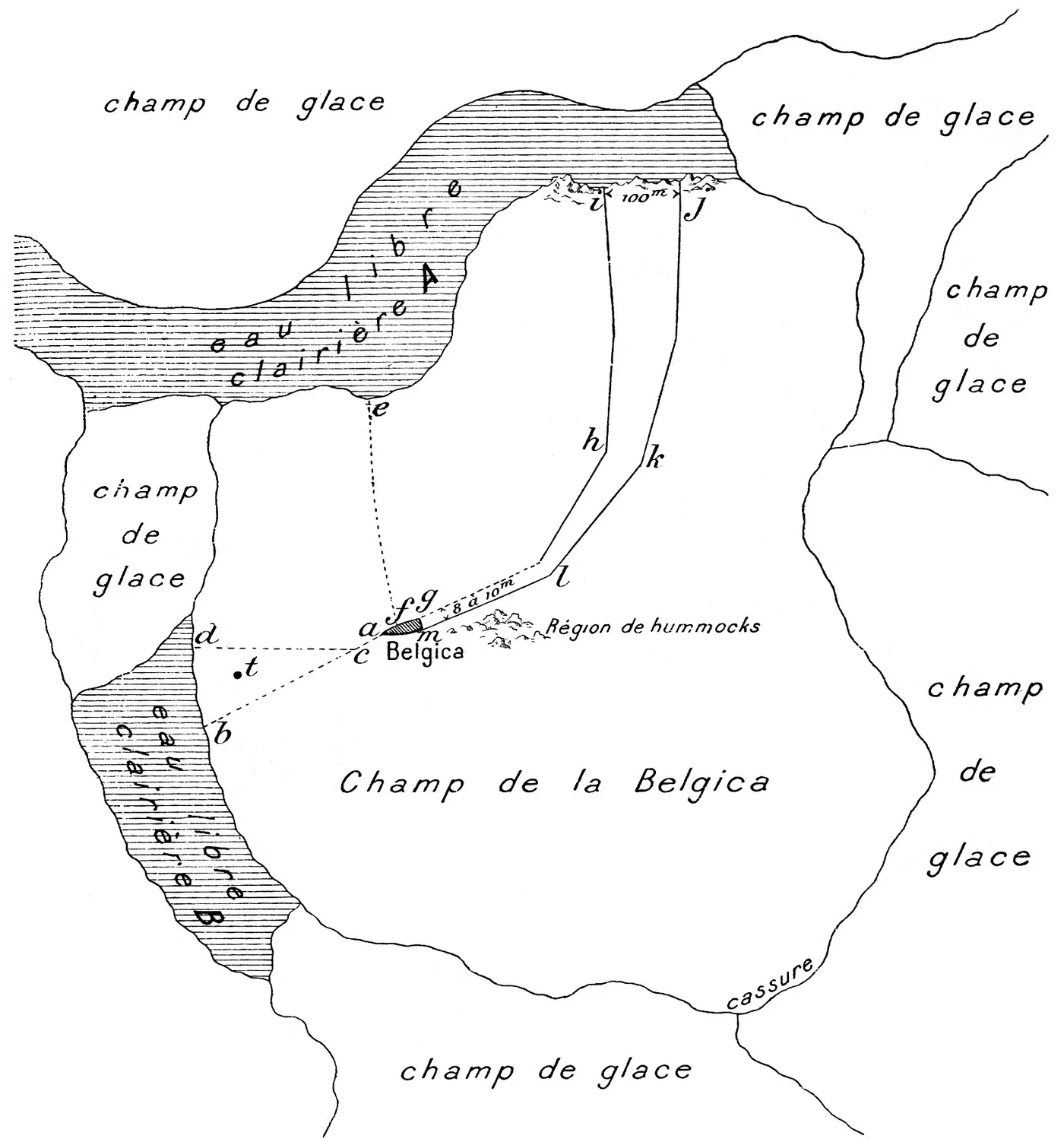
When the short Antarctic summer arrived in early 1899, the surrounding pack ice refused to break up. Belgica remained imprisoned behind nearly a kilometer of sea ice up to two meters thick. Facing another brutal polar winter meant almost certain death.
In January 1899, Cook and de Gerlache formulated an audacious escape plan: they would manually saw their way to freedom.
Armed with manual ice saws, axes, and tonite explosives, the seventeen surviving men laboured day and night in grueling shifts for nearly a month. They carved a channel nearly one kilometer long through the solid ice toward a nearby lead of open water (eau libre). On 15 February 1899, the severed channel widened just enough for Belgica to squeeze through, and following four harrowing weeks of navigating treacherous floes, they reached open ocean on 14 March 1899.
The expedition returned triumphant to Punta Arenas and Antwerp. They brought back over a year of unbroken hourly meteorological records, conclusive proof that Antarctica is a true continent under its ice cap, and the identification of more than 1,200 biological species — including the wingless midge Belgica antarctica, the largest purely terrestrial animal on the continent.
Historical Ties Between Norway and Belgium
The Belgica expedition was the finest expression of a multifaceted, centuries-old partnership connecting Norway and Belgium across sea, trade, and diplomacy:
1. Polar Brotherhood and Amundsen’s Mentorship
For Roald Amundsen, the Belgica was the defining crucible of his life. It was here that he grasped the vital importance of fresh meat against scurvy, witnessed de Gerlache’s unshakable composure under mortal threat, mastered Cook’s survival strategies, and tested skis and sledges in polar conditions. When Amundsen stood as the first human at the South Pole in December 1911, he repeatedly traced his success back to the lessons learned on Belgica.
De Gerlache’s love for Norway persisted throughout his life. In 1912, he founded the Polaris shipping venture in Sandefjord to construct a new polar expedition vessel at Framnæs Mekaniske Værksted. When financial constraints forced its sale, it was bought by Sir Ernest Shackleton, who renamed it the world-famous Endurance!
2. Belgica’s Final Resting Place in a Norwegian Fjord
Following Arctic research expeditions (1905–1909) with the Duke of Orléans to Svalbard and Northeast Greenland, the Belgica was sold back to Norwegian owners in 1916 and served as a coal carrier and fish processing ship in Harstad.
In May 1940, during the Allied defense of Narvik against Nazi invasion, British forces requisitioned Belgica as a floating ammunition depot. During a German Luftwaffe bombing raid, she was scuttled in the fjord at Skånland near Harstad. There, on the seabed of a quiet Norwegian fjord, the historic hull of Belgium’s legendary polar pioneer rests to this day.
3. Royal Kinship: Queen Astrid and Crown Princess Märtha
The Belgian and Norwegian royal houses have shared intimate family ties for a century. Princess Astrid of Sweden (1905–1935), daughter of Prince Carl of Sweden and Princess Ingeborg of Denmark, married Crown Prince Léopold (later King Leopold III of Belgium) in 1926, becoming Belgium’s deeply cherished Queen Astrid.
Queen Astrid was the younger sister of Norway’s beloved Crown Princess Märtha (the mother of King Harald V). Consequently, King Baudouin and King Albert II of Belgium were King Harald V’s first cousins. The royal families have nurtured close personal relationships across generations.
4. Antwerp Harbor and the Norwegian Seamen’s Church
As one of the world’s foremost commercial ports, Antwerp has served as a central artery for Norwegian shipping, timber, and cod since the age of sail. In 1865, the Norwegian Seamen’s Church in Antwerp (Sjømannskirken) was consecrated — the second oldest Norwegian seamen’s church in the world (surpassed only by Leith in Scotland). For well over a century, the mission in Antwerp provided hospitality and spiritual solace to tens of thousands of Norwegian sailors and expatriates.
5. Alliances, North Sea Energy, and Polar Science
Both Norway and Belgium endured Nazi occupation during World War II, contributed courageously to Allied merchant convoys from London, and stood together as founding members of NATO in 1949.
Today, their partnership is strategic and vital: since 1993, the undersea Zeepipe gas pipeline has transported massive volumes of Norwegian natural gas directly from the Troll field to the terminal at Zeebrugge, powering Belgian industries and serving as a crucial energy hub for continental Europe.
Furthermore, polar collaboration continues uninterrupted: Norwegian and Belgian polar scientists work closely together in Queen Maud Land in Antarctica, where Belgium’s state-of-the-art, zero-emission Princess Elisabeth Antarctica research station collaborates side by side with the Norwegian Polar Institute.
The Enduring Legacy of Adrien de Gerlache
Adrien de Gerlache never pursued sensationalism or nationalistic grandeur; he was an understated scientist who viewed his mission as an outpost for collective human knowledge.
Through his resolve, scientific rigor, and trust in Norwegian maritime craftsmanship, he unlocked the gateway to the White Continent. Today, the Belgica expedition remains an enduring testament to what nations can achieve when they combine courage, curiosity, and cooperation across the ice-choked frontiers of the globe.
Questions about The Belgica Expedition and Adrien de Gerlache: Antarctic Pioneer Feat and Norway's Ties with Belgium?
Tell us what you are looking for or when you wish to arrive. We are happy to advise and assist.
Write to Ophuz