





Cultural History · Tourism · The Kaiser Era
Kaiser Wilhelm II and Norway: How an Emperor Sparked Modern Tourism and Opened Innlandet
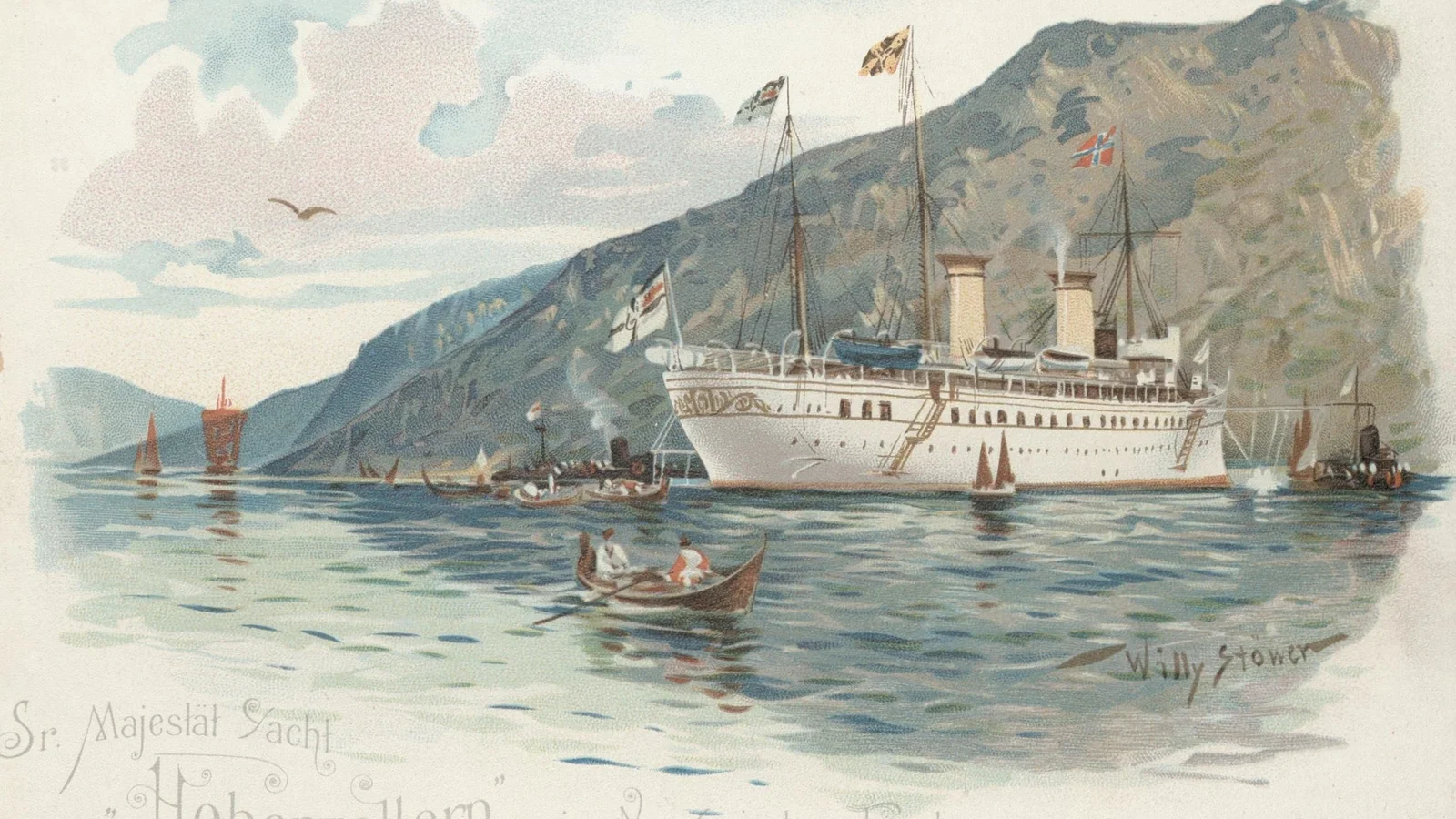
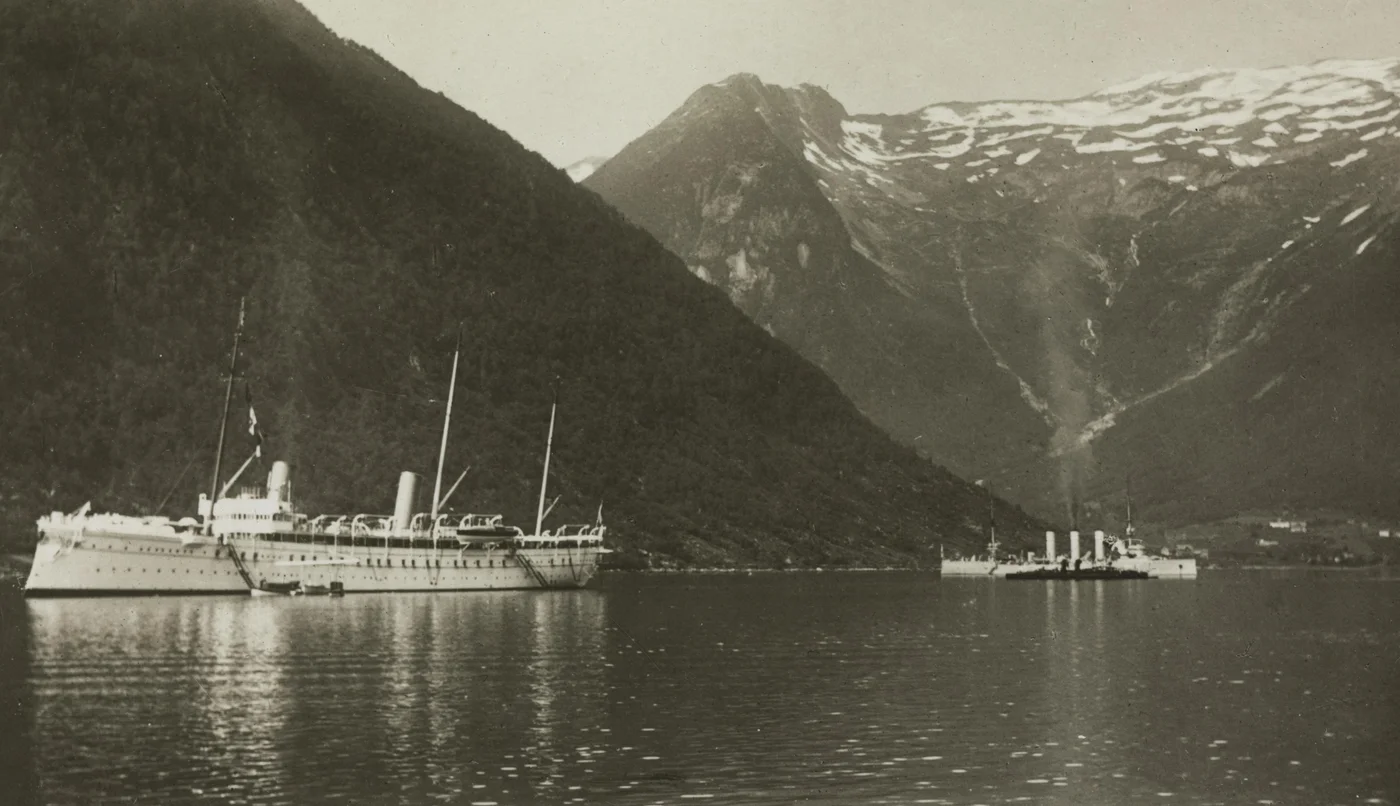
Every summer between 1889 and 1914, a majestic, 120-meter white steam yacht with two gleaming ochre-yellow funnels and an ornate gilded figurehead glided silently into Norway’s narrow glacial fjords. It was the imperial yacht SMY Hohenzollern, floating residence of the German Emperor and King of Prussia, Wilhelm II (1859–1941).
For a quarter of a century, the Kaiser spent his summer holidays in Norway on what were officially designated as his Nordlandfahrten (Northern Voyages).
His uninhibited infatuation with the dramatic Scandinavian landscape, the pure northern air, and Old Norse sagas functioned as a global publicity campaign. The Emperor’s annual royal presence ignited the era of modern Norwegian mass tourism. In the wake of his imperial flotilla came the crowned heads of Europe, British aristocrats, German university hikers, and the world’s very first luxury cruise liners. This transformative wave did not merely animate the coastal fjords of the west and the Lofoten archipelago—it rippled deep into the interior river valleys and subalpine highlands of Innlandet.
The Spark in Berlin: From Digermulen to the World Stage
The Kaiser’s enduring love affair with Norway began almost by chance. In 1888, the newly crowned young monarch attended an art exhibition in Berlin. There, he stood spellbound before landscape paintings by German artists Joseph Krieger and Adalbert Heine, who had recently explored Lofoten and Vesterålen. Their canvases captured the dramatic waters of the Raftsundet strait and the tiny coastal hamlet of Digermulen.
In his memoirs, Wilhelm II later recalled:
“I was so captivated by these paintings that I decided there and then to travel to Digermulen to see if it was really that beautiful there.”
In the summer of 1889, Hohenzollern set sail on its maiden Norwegian expedition. On Sunday, July 21, 1889, in radiant summer sunshine, the imperial yacht dropped anchor at Digermulen. The imperial party climbed the craggy peak of Digermulkollen (384 meters above sea level), where Wilhelm was so enchanted by the panoramic vista of jagged peaks and sea straits that his retinue erected a prominent stone cairn. To this day, the summit monument is known as Keiservarden (The Emperor’s Cairn).
That ascent marked the dawn of organized tourism in Northern Norway. Suddenly, Europe’s elite clamored to gaze upon what the Kaiser had seen. Regular passenger steamers, British private yachts, and German luxury cruisers swiftly added Digermulen and Raftsundet to their permanent northern itineraries.
The Fjord Empire: Balestrand and the Saga of Frithiof
While the Kaiser sailed as far north as North Cape and Spitsbergen, his true spiritual haven was Balestrand on the Sognefjord, where he returned year after year.
In Balestrand, Wilhelm struck up a warm, lifelong friendship with the celebrated Norwegian romantic landscape painter Hans Dahl (1849–1937), frequently visiting Dahl’s grand Dragon-style (dragestil) villa, Strandheim. Wilhelm strolled through Balestrand’s orchard gardens, mingled informally with locals, and indulged in Dahl’s romantic enthusiasm for the Viking Age.
Monumental Tributes: Vangsnes and Balestrand
The Kaiser’s passion for Frithiof’s Saga (Friðþjófs saga hins frœkna) inspired him to commission and personally finance two monumental bronze landmarks sculpted by German artist Max Unger:
- The colossal, 22-meter Fridtjof Statue on the promontory of Vangsnes, unveiled in 1913 in the presence of Wilhelm II and King Haakon VII of Norway.
- The statue of the legendary King Bele atop a burial mound in Balestrand.
The Kaiser’s Chair and the Eve of World War I
At Kviknes Hotel in Balestrand, visitors can still view the famous “Kaiser Chair” (keiserstolen). It was while seated in this carved wooden armchair on Saturday, July 25, 1914, that Kaiser Wilhelm was handed an urgent coded telegram rowed out from shore. It brought news of Austria-Hungary’s ultimatum to Serbia following the assassination in Sarajevo.
With a heavy heart, Wilhelm ordered immediate departure. Hohenzollern steamed south for Germany at maximum speed, and within days, Europe was engulfed in World War I. The carefree Belle Époque summer era in Norway was extinguished overnight.
The Ålesund Disaster of 1904: The Emperor’s Mercy Flotilla
The Kaiser’s bond with Norway was not merely an aesthetic pastime; it was cemented in the hearts of ordinary Norwegians by a legendary act of humanitarian relief.
On the freezing, storm-lashed night of January 23, 1904, a catastrophic fire swept through Ålesund. Within hours, more than 850 timber houses were reduced to smoldering embers, leaving over 10,000 citizens homeless in the dead of winter.
When the news reached Berlin, Wilhelm acted with lightning speed. Before any other foreign government had mobilized, the Kaiser dispatched four large German naval and merchant vessels directly from the naval base in Kiel, laden with field hospitals, medicines, emergency barracks, warm blankets, foodstuffs, and rebuilding supplies. German naval personnel provided shelter aboard ships and distributed hot food along the devastated quays.
Wilhelm also contributed substantial personal funds to rebuild the town and donated magnificent stained-glass windows to the newly erected Ålesund Church. In gratitude, the town erected a statue of the Kaiser in its municipal park, and one of Ålesund’s main thoroughfares still bears the name Keiser Wilhelms gate.
The Inland Tourism Explosion: Railways, Sanatoriums, and Mountain Hotels
While the Kaiser’s yacht cruised the western fjords, the international craze for Norway stimulated an equally profound transformation throughout the inland counties of Hedmark and Oppland (today’s Innlandet).
German Romanticism, Goethean nature philosophy, and British Victorian wanderlust aligned with the Kaiser’s royal endorsement. Norway came to embody the ultimate European ideal of pristine wilderness, health, and primeval tranquility.
1. The Railway Unlocks the Valleys
Until the late 19th century, traversing the great valleys of Gudbrandsdalen or Østerdalen was an arduous, bone-jarring trek by horse cart (karjol) along rutted dirt roads.
The opening of the Røros Railway through Østerdalen in 1877, followed by the progressive expansion of the Gudbrandsdal Line (reaching Tretten in 1894 and Otta in 1896), revolutionized access. Wealthy travelers from Oslo (then Christiania), Hamburg, Berlin, and London could now board comfortable express trains and reach the heart of the Norwegian interior within hours:
- Otta Station became a bustling northern terminal where passengers transferred to horse carriages and early open-top charabancs bound for Lom, Jotunheimen, and Geiranger.
- Railway stations along the Glomma and Gudbrandsdalslågen rivers fostered a flourishing ring of coaching inns, post stations, and family-run hotels.
2. The Sanatorium Movement and High-Mountain Therapy
During the late 19th century, European medicine embraced high-altitude therapy (høifjeldskur). Physicians believed that the dry, ozone-rich subalpine air and fragrant pine forests could heal tuberculosis, chronic respiratory ailments, anemia, and the “nervous exhaustion” of modern city life.
Innlandet, with its sheltered continental rain shadow and vast highland plateaus, became the Scandinavian epicenter of health tourism:
- Gausdal Sanatorium (Skeikampen): Founded on July 1, 1876, by the visionary medical doctor Ingebrigt Christian Holm, this was Norway’s very first purpose-built mountain sanatorium, establishing Skeikampen as a premier resort.
- Tonsåsen Sanatorium (Valdres): Established in 1881, Tonsåsen became one of Northern Europe’s most famous health spas and tuberculosis sanatoriums, nestled amidst therapeutic pine forests.
- Lillehammer, Mesnali, and Gålå: Guesthouses and convalescent homes sprouted across the sun-drenched hillsides. Innovator Johan Chr. Sørensen developed early mountain lodges on the Gålå plateau after experiencing the curative power of its air, while Lillehammer transformed into a magnetic retreat for convalescents, painters, and authors.
3. British “Salmon Lords” and German Wanderers
Along the winding waters of the Glomma, Trysilelva, and Gudbrandsdalslågen, an elite class of British sportsmen—affectionately dubbed “salmon lords” (lakselorder)—leased exclusive fishing rights for decades, building rustic log hunting lodges or residing in historic grand manor farms.
Simultaneously, German travelers, fired by romantic Nordic enthusiasm, sought the wilderness of the interior fells. Armed with rucksacks, alpine walking sticks, and watercolor pads, German scholars, students, and engineers trekked across the plateaus of Rondane and the rugged massifs of Jotunheimen. They stayed at traditional mountain summer dairy farms (setrer), where farm maidens served freshly skimmed sour cream, crisp flatbread, and cold well-water, fueling an unprecedented membership boom in the Norwegian Trekking Association (DNT).
4. From Dairy Huts to Swiss-Style Grand Hotels
Throughout the 1890s and 1900s, Innlandet’s hospitality infrastructure underwent a magnificent architectural evolution. Rustic coaching inns were replaced or expanded into palatial wooden hotels in Swiss chalet style and Dragon style, adorned with sweeping verandas, intricate fretwork, and elegant dining rooms. Landmarks like Fefor High Mountain Hotel (established 1891) and the iconic station hotels offered continental refinement in the shadow of majestic peaks.
An Era That Redefined Norway
When the guns of August 1914 shattered the peace of Europe, the carefree era of Wilhelmine summer cruising came to an abrupt, permanent end. Hohenzollern never sailed into a Norwegian fjord again, and the German Empire collapsed in 1918.
Exile in Holland: The Woodcutter of Doorn
As revolution swept Germany in November 1918, Wilhelm II abdicated. On the morning of November 10, the man who had once commanded the world’s second-largest navy crossed the Dutch border at Eijsden as a private refugee. The neutral Netherlands granted him asylum, and when the victorious Allies demanded his extradition to stand trial for “a supreme offence against international morality” (Article 227 of the Treaty of Versailles), Queen Wilhelmina flatly refused to hand him over.
The former emperor first lodged at Kasteel Amerongen with Count Godard van Aldenburg-Bentinck — a stay intended to last three days that stretched to a year and a half. In 1919 he bought the manor house Huis Doorn near Utrecht, where he lived for the remaining two decades of his life. To furnish it, his belongings were shipped from his German palaces in dozens of railway wagons (most accounts say 59), filled with furniture, paintings, silver, and porcelain.
At Doorn, the former Supreme Warlord found an unexpected new passion: chopping wood. Almost every morning, Wilhelm went out into the estate grounds to fell and saw trees, often accompanied by his adjutants. Over the years he cut down many thousands of trees, and he became so identified with his axe that he autographed wood chips and small logs, handing them out to visitors as souvenirs. Dutch locals, with dry humour, nicknamed him the woodcutter of Doorn.
A few more curious facts about the Kaiser:
- The withered arm: A difficult breech birth in 1859 left Wilhelm’s left arm about 15 cm shorter than the right. Throughout his life he hid it in photographs by resting his hand on a sword hilt, a glove, or a pocket.
- Queen Victoria’s grandson: Wilhelm was the eldest grandchild of Queen Victoria, who died in his arms at Osborne House in 1901. Britain’s King George V was his first cousin, as was Tsarina Alexandra of Russia — making the First World War, in part, a war between royal cousins.
- The famous moustache: His upturned moustache was shaped every morning by the court barber François Haby, who marketed a moustache wax under the slogan “Es ist erreicht” (“It is achieved”). The style became a fashion craze across Germany.
- Scholar in exile: At Doorn, Wilhelm wrote his memoirs, hosted learned gatherings on archaeology and cultural history (the Doorner Arbeitsgemeinschaft), and remained fascinated by the excavations he had sponsored on Corfu, where he owned the Achilleion palace.
- Remarriage: After the death of Empress Augusta Victoria in 1921, he married the widowed Princess Hermine Reuss of Greiz in 1922.
- A final refusal: When German troops occupied the Netherlands in May 1940, Winston Churchill offered him asylum in Britain. Wilhelm declined, preferring to stay at Doorn.
- He never went home: Wilhelm died at Huis Doorn on June 4, 1941, aged 82. He had ordered that his body should not return to Germany unless the monarchy was restored. He still lies in a small mausoleum in the park at Doorn — and Huis Doorn is today a museum where visitors can see the rooms just as he left them.
Wilhelm never saw the fjords again. Yet his name endures in Norway — on the Keiservarden cairn above Digermulen, on Keiser Wilhelms gate in Ålesund, and in the great bronze Fridtjof gazing over the Sognefjord.
A Lasting Legacy
Yet those 25 years of royal patronage had indelibly transformed Norway:
- Tourism emerged as one of the country’s most vital, resilient economic sectors.
- Coastal jewels like Balestrand, Geiranger, and Digermulen were permanently etched onto the world travel map.
- The coast and the interior were stitched together by an integrated railway and roadway network.
- And the valleys and highlands of Gudbrandsdalen and Østerdalen developed a proud tradition of mountain hospitality, sanatorium culture, and outdoor recreation that remains the hallmark of Innlandet to this day.
Questions about Kaiser Wilhelm II and Norway: How an Emperor Sparked Modern Tourism and Opened Innlandet?
Tell us what you are looking for or when you wish to arrive. We are happy to advise and assist.
Write to Ophuz