








Military History · Solør 1808
The Battle of Trangen: The Napoleonic Wars in the Deep Boreal Forests
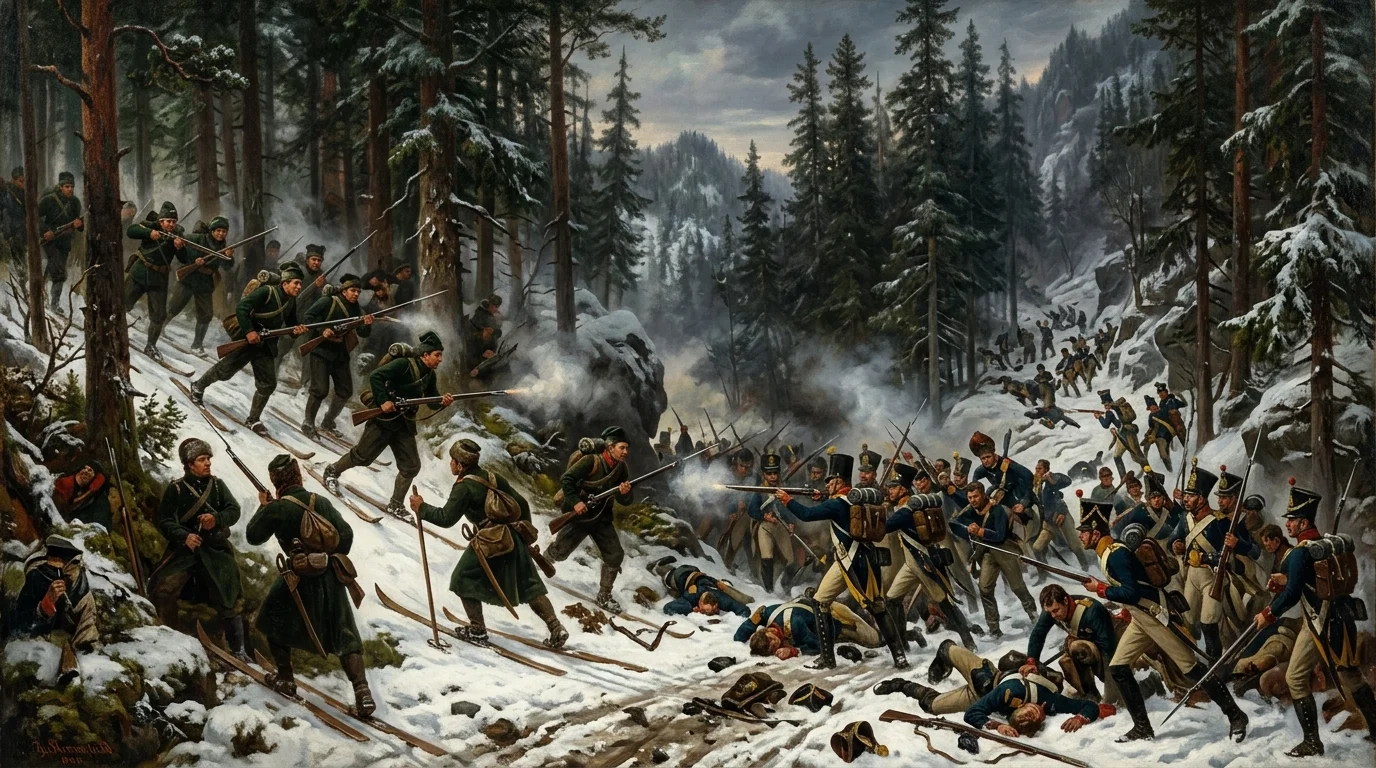
In the spring of 1808, the Napoleonic Wars engulfed Europe, and their reverberations reached the silent pine wilderness of eastern Norway. On April 25, 1808, one of the most famous tactical engagements on Norwegian soil was fought in a narrow forested defile in Åsnes: The Battle of Trangen (Slaget ved Trangen).
Here, just down the Glomma river valley from Opphus, a Swedish invasion column was lured into a masterfully orchestrated ambush. Through deep spring snow and dense boreal forest, Norwegian ski troops and grenadiers encircled Colonel Gahn’s Swedish detachment. The battle generated enduring national lore—most notably Captain Dreyer commanding from a pine stump—while standing at the heart of the global clash between Napoleon Bonaparte, Tsarist Russia, and the British Empire.
The Bigger Picture: Napoleon’s Continental Blockade and the Nordic Front
To grasp why Swedish and Norwegian soldiers fought to the death amongst the pine ridges of Åsnes, one must look at the grand chessboard of the Napoleonic Wars:
- The Bombardment of Copenhagen (1807): Fearing that Napoleon would seize the formidable Dano-Norwegian navy, the British Royal Navy preemptively bombarded Copenhagen in September 1807, confiscating virtually the entire fleet. This brutal raid pushed neutral Denmark-Norway into an alliance with Napoleon Bonaparte and compelled it to join the Continental Blockade (Continental System) against Britain.
- The British Blockade and Norwegian Famine: Britain retaliated with an airtight naval blockade of the Skagerrak and North Sea. Merchant vessels carrying grain from Denmark were intercepted and sunk. Norway was plunged into devastating famine—the legendary “bark-bread years” (barkebrodtider) commemorated in Henrik Ibsen’s epic poem Terje Vigen.
- The Finnish War and Sweden’s Dilemma: In Stockholm, the fervently anti-Napoleonic King Gustav IV Adolf refused to close Swedish ports to British trade. At the Treaty of Tilsit in 1807, Napoleon gave Tsar Alexander I of Russia a free hand to pressure Sweden. In February 1808, Russian armies invaded Swedish Finland.
- War on the Western Front: Pressured by Napoleon to open a second front against Sweden, Denmark-Norway declared war in February 1808. King Gustav IV Adolf envisioned conquering Norway to compensate for territorial losses in Finland, ordering his Western Army to invade southeastern Norway along several axes toward the Glomma.
The Swedish Push Toward the Glomma
Colonel Karl Pontus Gahn led a Swedish vanguard of 500 to 600 soldiers from the Dalarna and western frontier regiments across the border on April 24, 1808. His objective was daring: advance along the Flisa River, seize the crossing at Flisa, sever communications along the Glomma corridor connecting Christiania (Oslo) with Østerdalen and Trondheim, and outflank the main Norwegian defense.
However, Gahn advanced with overconfidence and without reconnaissance guards protecting his flanks. Awaiting him in the Solør forests was Colonel Bernhard Ditlef von Staffeldt, an experienced and calculating commander intimately familiar with the northern wilderness.
The Ambush at the Abatis
The Norwegian defenders turned the boreal geography into a lethal trap. At Trangen, where the road was squeezed into a narrow defile between the steep forested slopes of Buttenåsen and Kjelsåsen, engineers had constructed a massive forhugning (abatis)—a formidable barricade of felled pines and crisscrossed logs blocking the road.
Concealed behind this barricade lay Captain Elias Nægler with two companies of the Throndhjem Grenadier Battalion. When Gahn’s column struck the timber wall, they were met by point-blank musket volleys from unseen positions, bringing the Swedish advance to a dead halt.
Simultaneously, the second jaw of the trap snapped shut:
- Major Johan Georg Ræder led three grenadier companies across the Flisa River to cut off Gahn’s line of retreat.
- The Elverum ski troops (Elverumske skiløpere) and the Southern Ski Battalion (Den søndenfjeldske Skiløberbataljon), drawn from woodsmen of Hedmark and Østerdalen, glided swiftly across the rotting spring crust on wooden skis. While Swedish infantry floundered waist-deep in melting slush, the Norwegian ski marksmen flanked the heights and poured devastating plunging fire into the trapped column.
Captain Dreyer on the Stump
Surrounded and boxed into the ravine, the Swedish troops fought with fierce resolve. Colonel Gahn ordered repeated bayonet charges in both directions to smash through the encirclement.
Amidst the gunfire, one of the most famous moments in Scandinavian military history took place: 35-year-old Captain Nikolai Peter Dreyer, commanding the Trønder light infantry company, climbed atop a tall pine tree stump (Dreyerstubben) beside the path. Elevated above the gunsmoke and deep snow, Dreyer coolly rallied his men, directing their fire and discharging his own weapons until struck multiple times. Mortally wounded, he was carried to Sønsterud farm, where he died four days later. The stump became a revered national landmark, and the site is today protected as the Dreyerstubben Nature Reserve.
Total Capitulation
After several hours of ferocious close-quarters fighting in the woods, the Swedes exhausted their ammunition. Boxed in between the abatis and the ski companies, Colonel Gahn raised the white flag:
- 445 Swedish soldiers and 11 officers were taken prisoner, including Colonel Gahn himself.
- 25 Swedish soldiers lay dead on the field, and 57 were wounded.
- Only 115 men of Gahn’s detachment escaped through the trackless wilderness back to Värmland.
- Norwegian casualties totaled 15 dead and 52 wounded. The fallen of both nations were buried with full military honors in a common grave at Åsnes Church.
The Road to 1814
The victory at Trangen was far more than an isolated forest skirmish. It repelled the Swedish northern offensive against the Glomma, secured Østerdalen, and provided an immense morale boost to a starving and isolated Norwegian nation.
On the European stage, this conflict triggered a profound sequence of events:
- Disaster in Finland and setbacks in Norway prompted a coup d’état in Stockholm in 1809 that deposed King Gustav IV Adolf.
- To succeed him, the Swedish parliament elected Napoleon’s own marshal, Jean-Baptiste Bernadotte (later Crown Prince Carl Johan).
- Carl Johan forged an alliance with Britain and Russia against Napoleon, extracting Norway as his prize at the Treaty of Kiel in January 1814.
- Norway rebelled against being ceded, leading directly to the national assembly at Eidsvoll, the Norwegian Constitution of May 17, 1814, and the subsequent dual monarchy with Sweden.
Today, absolute silence reigns over the mossy forests of Trangen. The stone monument and the legend of Captain Dreyer stand as poignant reminders that even in the quietest boreal woodlands along the Glomma, the titanic tides of world history left their permanent mark.
Questions about The Battle of Trangen: The Napoleonic Wars in the Deep Boreal Forests?
Tell us what you are looking for or when you wish to arrive. We are happy to advise and assist.
Write to Ophuz